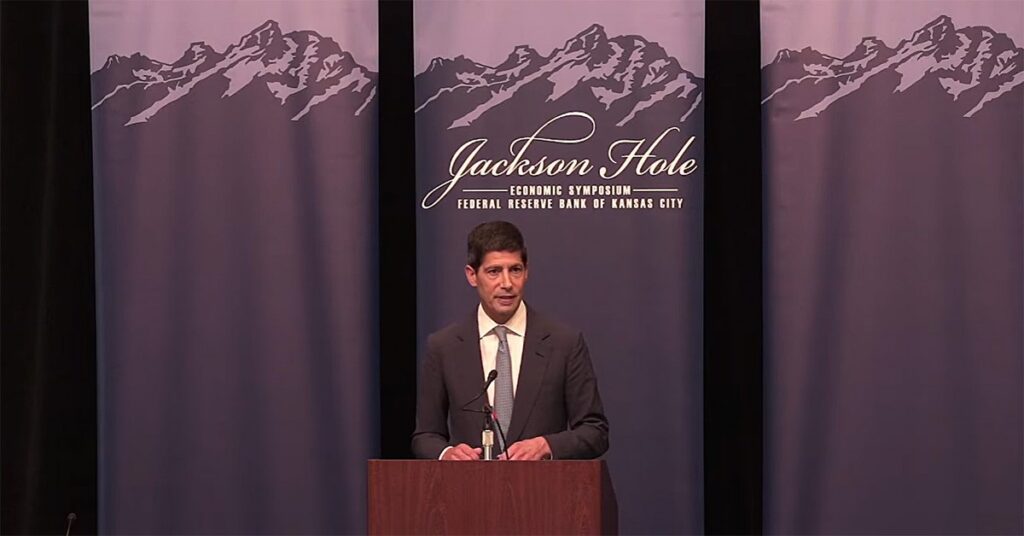
Describing the current economic moment as “a time of great consequence,” Kevin Warsh took the podium in Jackson Hole, Wyo., at his first major speech as Federal Reserve chairman and cautioned that progress toward the U.S. central bank’s inflation goals has stalled.
“We must be confident that underlying inflation is moving to our objective clearly and at sufficient speed, otherwise we have work to do,” stated Warsh on Friday morning, offering one of his sharpest assessments on the trajectory of rising prices and how the Fed may combat them under his leadership.
Since succeeding Jerome Powell as Fed chair in May, Warsh has begun to institute a slew of reforms, the most immediate and visible of which has been the elimination of forward guidance from policy announcements and commentary.
While summer trends in the personal consumption expenditures (PCE) index and consumer price index (CPI) have been “better than expected,” Warsh conceded, he added that “they do not tell me that underlying trends meaningfully improved.”
The PCE index, which is the Fed’s preferred inflation gauge, rose 3.7% over the 12 months ending in July, with the six-month change above 4%, said Warsh. Core measures of both PCE and CPI that remove volatile energy and food prices remain elevated, he noted.
“On balance, I would be hard-pressed to describe broad financial conditions as restrictive,” said Warsh, noting inflation-adjusted consumer spending has been “healthy,” despite shocks from Trump administration tariffs and the ongoing Iran war.
He described expectations for growth in business investment and corporate earnings as “quite high,” with roughly half of capital expenditures over the past year spurred by spending related to artificial intelligence.
Bond banter
Corporate bond supply has been strong, Warsh said, understating the impact that shifting supply-demand dynamics at the long end of the U.S. Treasury yield curve have had on borrowing costs more broadly.
On that front, Warsh made no direct mention of recent market meddling by Treasury Secretary Scott Bessent, who has been criticized for perceived attempts to bring down longer-term bond yields that have surged in recent weeks.
Bessent made a surprise announcement on Aug. 19 that Treasury would be doubling the size of its longer-dated bond buybacks, eliciting blowback from Stanley Druckenmiller, the Wall Street titan and longtime Bessent and Warsh mentor.
But Warsh may have taken a veiled poke at Bessent’s policy maneuvers when he stated: “I know it’s not fashionable these days, but my view is that money has something to do with monetary policy. We should pay attention to money created by the central bank and money that comes from the banking and financial system.”
A hawkish tilt?
While financial markets may interpret the Fed chair’s closely watched Jackson Hole speech as hawkish on interest rate hikes ahead of the Federal Open Market Committee’s upcoming meeting in September, Warsh was unrelenting about his intention to reset expectations between the U.S. central bank and financial markets.
Warsh described forward guidance as being “essential at the time” when it was implemented to calm markets during the 2008 financial crisis, but he believes it is a “legacy of crises past” and a practice that has “outstayed its welcome.”
He also eschewed other monetary tactics taken during periods of economic crisis, stating that “short-term interest rates are the predominant tool to achieve the dual mandate” of price stability and full employment.
“Unconventional policies to spur economic activity may suit genuine crises — of which we all have much experience — but they should otherwise be used sparingly, if at all,” the Fed chair said.
Warsh repeated his desire for setting monetary policy based on market signals that are “as unfiltered as possible,” noting that “to get policy right, we also have to get the relationship right between the central bank and financial markets.”
He added: “We should not indulge a regime in which market participants are looking primarily to the Fed for their next trade.”
But interest-rate traders did take Warsh’s words as a signal to make their next trade. CME FedWatch, which tracks futures contracts tied to the anticipated direction of the benchmark federal funds rate, reported roughly 60% odds of a Fed rate hike in September following Warsh’s remarks. The prior day, those odds stood at 35%.
“All told, expect higher short-term rates as the Fed focuses on lowering inflation, but don’t expect a lot of communication about how and when the decision to raise rates will be done,” noted Mark Fleming, chief economist of First American Financial Corp., sharing his reaction to Warsh’s speech with Scotsman Guide.