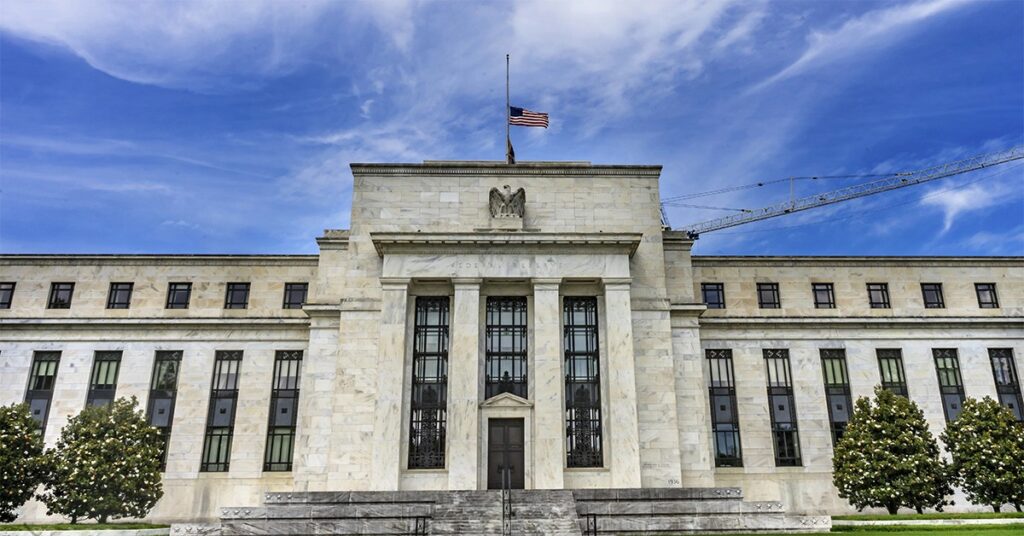
For the first time since 2023, the Federal Reserve decided to raise interest rates.
Wednesday’s unanimous decision elevates the benchmark federal funds rate by a quarter point to a range of 3.75% to 4%. It follows five consecutive rate holds, two of which were presided over by Fed Chairman Kevin Warsh, who took office in May.
“Economic activity is expanding at a solid pace,” the official policy statement read. “While uncertainty remains elevated owing, in part, to geopolitical developments, domestic spending has been resilient. Productivity growth is strong, and capital investment is robust. Job gains have kept pace with the workforce, and the unemployment rate has changed little.”

The statement concluded: “Inflation remains elevated. Today’s policy action will support a timelier return to the committee’s 2% goal. The committee will deliver price stability.”
Sixteen of the 18 members of the Federal Open Market Committee (FOMC) who submitted forecasts to the quarterly Summary of Economic Projections predict at least one additional rate hike in 2026. Four members foresee two more quarter-point hikes this year.
One FOMC member — presumably Warsh, who shuns forward guidance — did not submit a projection.
The last rate movements were downward, with the U.S. central bank executing three straight quarter-point cuts to close 2025.
But inflation has remained well above the Fed’s 2% target since the Iran war broke out in late February. Its preferred inflation gauge peaked at a 4.1% annual rate in May, but has remained at a lofty 3.7% in subsequent readings.
On the other side of the Fed’s dual mandate, the labor market has shown persistent resilience. In August, nonfarm employers added a healthy 162,000 jobs, with the unemployment rate anchored at 4.1% — generally considered within the range of full employment.
The hike to short-term borrowing costs comes at a fraught time for global bond markets. On Tuesday, the 10-year U.S. Treasury yield breached 5% and the 30-year yield surpassed 5.4%, both hitting their highest levels since 2007.
Mitch Ginsberg, founder and executive chairman of commercial real estate lending platform CommLoan, believes the rate hike will require lenders to broaden their capital market strategies.
“Today’s increase adds real pressure to a bond market that was already jittery, and CRE borrowers will feel it directly through higher yields and higher borrowing costs, particularly on loans priced off bond market benchmarks,” Ginsberg said in emailed commentary.
“But the bigger story here isn’t new demand drying up. It’s whether borrowers can secure enough loan proceeds to retire existing debt under today’s rates and underwriting standards,” Ginsberg added. “That gap between what a loan used to support and what it supports now is where deals get stuck, and borrowers who lean on the same handful of lender relationships are taking on unnecessary risk in this environment.”
Fed rate hike widely expected
On Tuesday evening, after the FOMC concluded the first of its two closed-door sessions, odds of a Fed rate hike stood around 92%, according to CME FedWatch.
Comments received by Scotsman Guide in advance of the decision reinforced the sentiments of interest-rate traders tracked by that CME Group tool.
“Inflation is clearly going in the wrong direction, oil prices are surging, and there’s no immediate sign of a positive change in inflation figures,” Melissa Cohn, regional vice president of William Raveis Mortgage, observed in an email. “It’s likely to get worse before it gets better.”
Sam Williamson, senior economist at First American Financial Corp., flagged the stronger August job growth and firmer inflation readings, noting that steadily climbing Treasury yields had priced in a more restrictive stance by Fed policymakers.
“Tighter Fed policy may initially keep borrowing costs elevated, but it could eventually open the door to lower mortgage rates if investors grow more confident that inflation is coming under control,” Williamson said.
Charles Goodwin, head of bridge and debt-service coverage ratio lending at Kiavi, also saw upside for residential borrowers in the anticipated rate hike.
“While this may feel like bad news for potential homebuyers, it’s important to note that this move does not necessarily translate into an increase in mortgage rates, which are more closely tied to longer-term Treasury yields and have already absorbed some expectations for tighter monetary policy,” Goodwin said.
Warsh takes a stand
To say that Kevin Warsh walked into a hornet’s nest when he accepted his dream job might actually be an understatement.
The April FOMC meeting — the last of Jerome Powell’s second term as Fed chair — produced four dissents, the most since 1992.
Warsh also inherited a sticky yet volatile inflation situation. Inflation had exceeded the central bank’s 2% target for more than five years when he took office, but the nascent Iran war made it difficult to segregate supply-side oil shocks from inflationary AI demand and the lingering impacts of 2025’s wave of Trump administration tariffs.
On top of that, Warsh was critical of Powell’s higher-for-longer rate regime when auditioning for the job, and President Donald Trump believes interest rates should be considerably lower.
“We should be paying the lowest interest rate in the world,” Trump told reporters Sunday while attending the final round of the Irish Open golf tournament.
Warsh’s first FOMC press conference in June received mixed reviews, but his July presser was widely criticized, with bond markets reacting harshly to the disconnect between his tough inflation rhetoric and the committee’s inaction.
Many Fed watchers viewed Warsh’s inaugural Jackson Hole speech on Aug. 28 as restoring central bank credibility. Its pivotal line, in which Warsh said the Fed would “have work to do” if underlying inflation did not move toward its objective “clearly and at sufficient speed,” set the table for the September rate hike.