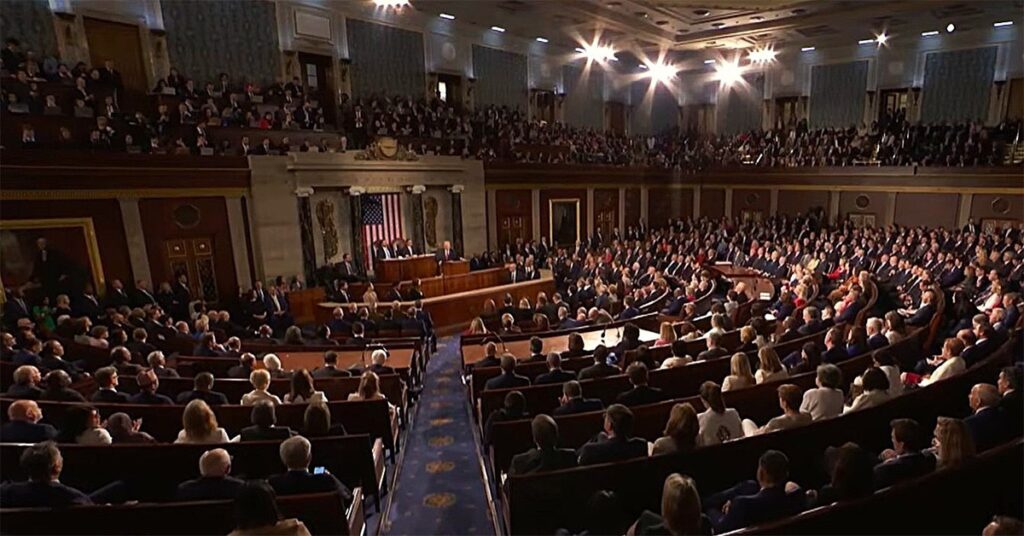
During a State of the Union address that shattered duration records, President Donald Trump devoted less than three minutes of a speech lasting approximately 1 hour, 48 minutes to discussing his plan to tackle the affordable housing crisis in the United States.
Trump provided no new housing policy proposals during his address, instead asking Congress to codify his previously announced plan to ban institutional investors from purchasing single-family homes.
“Another pillar of the American Dream that has been under attack is homeownership,” Trump stated as he closed in on the one-hour mark, before citing the executive order he signed on Jan. 20 titled “Stopping Wall Street from Competing with Main Street Homebuyers.”

“Now I’m asking Congress to make that ban permanent,” Trump declared, “because homes for people, really, that’s what we want. We want homes for people, not for corporations. Corporations are doing just fine.”
Trump then pivoted to a discussion of protecting retirement benefits for seniors, though he made no mention of a briefly floated proposal to allow the use of 401(k) retirement funds for mortgage downpayments.
The president’s address to the nation coincided with a tense moment of his second term in the White House. Last Friday, the Supreme Court struck down Trump’s signature tariff policies in a 6-3 decision, deeming that he had exceeded his executive authority by implementing tariffs under the International Emergency Economic Powers Act without the legislative blessing of Congress.
Four of the Supreme Court’s nine justices were present for Tuesday night’s speech, including three who ruled against him: Amy Coney Barrett, Elena Kagan and Chief Justice John Roberts. The president courteously shook hands with each jurist before stepping to the podium — including Barrett, who was among the justices who had received an unprecedented tongue-lashing from Trump in a post-ruling press conference.
Trump claimed that despite the “very unfortunate ruling” from the Supreme Court, “almost all countries and corporations” would still go along with the previously enacted tariffs out of fear of more punitive measures he has vowed to pursue under alternative legal means.
“Congressional action will not be necessary,” Trump stated. “It’s already time-tested and approved, and as time goes by, I believe that tariffs paid for by foreign countries will, like in the past, substantially replace the modern-day system of income tax, taking a great financial burden off the people that I love.”
Many economists have disputed Trump’s assertion that foreign countries assume the primary cost burdens of tariffs. A study released earlier this month by the Tax Foundation, a nonprofit think tank, found that Trump administration tariff policies resulted in an average cost increase of $1,000 per U.S. household in 2025.
Trump also claimed that during the last three months of 2025, core inflation was 1.7%. According to personal consumption expenditures (PCE) price index data — the Federal Reserve’s preferred inflation metric — core PCE inflation less food and energy prices stood at 2.7% in October, 2.8% in November and 3% in December.
“Mortgage rates are the lowest in four years, and falling fast, and the annual cost of a typical new mortgage is down almost $5,000 just since I took office,” Trump asserted directly after the inflation discussion.
Trump’s mortgage affordability claim is an overstatement. According to data from the Mortgage Bankers Association, the national median monthly mortgage payment applied for by purchase applicants was $2,025 in December, which equates to a $24,300 annual outlay.
In January 2025, when Trump was sworn in for his second term, the median payment amount was $2,205, or $26,460 annually. That’s a $2,160 difference in affordability.
Looking back at Freddie Mac data from four years ago, the 30-year fixed-rate mortgage averaged 3.92% during the third week of February. As of the seven-day period ending last Thursday, the 30-year rate averaged 6.01%.
But mortgage rates are down notably since Trump took office. As of Jan. 16, 2025, four days before Inauguration Day, interest rates averaged 7.04% for a 30-year loan.
However, “falling fast” is an exaggeration. Since the beginning of 2026, mortgage rates have remained in a tight range, only briefly dipping below 6% before meeting resistance.