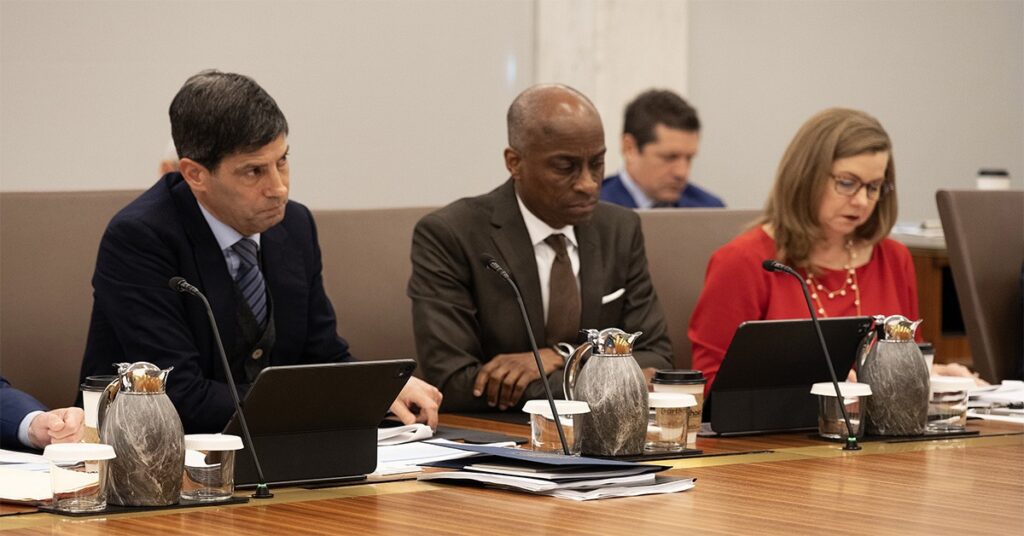
The decision at the Federal Reserve’s June monetary policy meeting was unanimous: Hold the benchmark borrowing rate steady at 3.5% to 3.75%.
But a few members of the Federal Open Market Committee (FOMC) indicated there was a “case for raising the target range for the federal funds rate,” according to the meeting minutes released Wednesday.
The Fed typically raises interest rates to cool an overheating economy and maintain price stability when inflation is too high.
Inflation dominated the conversation around the boardroom table, the minutes show.
“With inflation having run significantly above 2% over the past five years and in light of some emergent price pressures that appeared unrelated to tariffs or energy prices, the staff continued to view the possibility that inflation would be more persistent than projected as a salient risk,” the minutes state.
In another notable passage, FOMC meeting participants attributed increases in both core and total inflation to a combination of lingering tariff impacts, supply chain disruptions from the Strait of Hormuz closure and AI-related demand for certain goods and services.
“Several participants commented that price pressures had become more broad based,” the minute-taker wrote, “with a large share of goods and services — including transportation, airfares, petrochemical products and agricultural inputs — experiencing substantial increases.”
At the same time, uncertainty around Fed officials’ inflation forecasts was characterized as “elevated,” due to both the unpredictable economic effects of the Iran war and a lack of clarity surrounding short- and long-term inflationary impacts of artificial intelligence investment and adoption.
After the meeting concluded on June 17, Fed Chairman Kevin Warsh vowed to tackle the inflation side of the central bank’s dual mandate to maintain price stability and maximum employment.
“I’ve said for years, inflation is a choice,” Warsh told reporters at his first press conference as chair. “You bet it is, and today I’m announcing that this committee unambiguously and unanimously have decided we are going to deliver on that.”
The next FOMC meeting is scheduled for July 28-29. The market-implied odds of a rate hike decision at that gathering currently sit around 30%, according to the CME FedWatch tool.
But as of Wednesday afternoon, futures trading tracked by CME Group shows about 70% odds of at least a quarter-point rate increase by September, with 86.5% chances of monetary tightening by year-end.