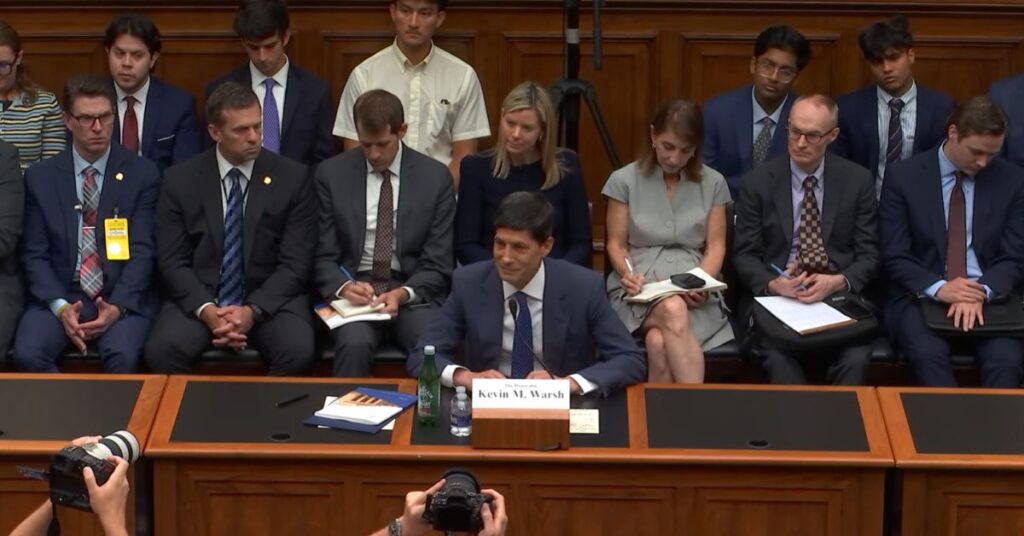
Federal Reserve Chair Kevin Warsh reiterated his “resolute commitment” to bringing down inflation and preserving the independent conduct of U.S. monetary policy during semiannual testimony before the House Committee on Financial Services on Tuesday.
During his testimony, Warsh called ongoing advancements in artificial intelligence “perhaps the most significant change in our economy in my adult lifetime.” His remarks underscored both the pace of AI business investment, which he called “the most striking feature” of the U.S. economy, as well as the capacity for AI to disrupt job demand and amplify national security concerns.
Despite rising AI-related job anxieties among consumers, Warsh described a U.S. labor market characterized by job creation that has “kept pace with the workforce” and unemployment that has remained at low and stable levels over the past year at slightly above 4%.

He also said on numerous occasions that he intended to keep the Fed “in its lane” of monetary policy and out of the purview of politics or fiscal policy. That included a reluctance to “relitigate” past policy decisions made under Powell’s leadership during the Biden administration, which critics label “mission creep.”
“The independence of the Federal Reserve is sacrosanct,” stated Warsh, when asked by Rep. Emanuel Cleaver, D-Mo., to address the importance of independent monetary policy.
“Part of the reason for the Fed’s power comes not just from the printing press, though it can be useful from time to time,” Warsh said. “It comes from our credibility,” he continued, describing that credibility as Fed policymakers’ capacity to “make the best choices we can consistent with the law that you’ve written for us.”
Warsh also faced questions about how higher interest rates since 2022 have contributed to persistent housing affordability challenges, disproportionately impacting first-time homebuyers and low- to moderate-income households. Balance sheet expansion and a federal funds rate near 0% for more than two years from 2020 to 2022 created a “boom and bust” cycle that Warsh believes monetary policy should avoid.
“We don’t target any particular sector, but the decisions we make have a big affect on housing,” said Warsh, who drew distinctions between optimism in manufacturing output and tech investment with a “somewhat more cautious note” concerning the housing market, which is now showing regional fragmentation in the aftermath of pandemic-era distortions.
“I would prefer a set of monetary policies that are not boom and bust, that don’t just make one generation more fortunate about being able to afford their first home than the next,” said Warsh.
With only seven weeks of Fed leadership under his belt since succeeding former Chair Jerome Powell in late May, Warsh has worked quickly to begin a comprehensive process of central bank reforms that Fed critics say are overdue.
Warsh faced questions Tuesday linked to the five task forces he established to review balance sheet policy, communications, data, productivity and jobs, and inflation frameworks.
Rep. Frank Lucas, R-Okla., who chairs the committee’s task force on monetary policy, asked Warsh what he anticipates from the Fed task forces, as well as what kind of public disclosures or reports should be expected.
“There’s going to be nothing held in secret here,” Warsh assured the committee, saying the task forces will first share their findings with decision-makers at the Fed. “This is a public discussion on these five [reform areas], and I’m happy to share the results and the thinking periodically between now and the end of the year, at which point I hope we’ve got some real conclusions.”
Warsh also committed to publicly preview, explain and debate changes to Fed balance sheet policy, while providing “good advance notice” to any modifications.
Rep. Brad Sherman, D-Calif., the ranking member of the House Subcommittee on Capital Markets, commended Warsh for seeking to improve the Fed’s data collection processes, which have long relied on survey responses. The response rates to those surveys have steadily declined in recent years.
Of more immediate concern for lawmakers and financial markets is how the pullback in forward guidance and Fed communications that Warsh has initiated may inject uncertainty into evolving economic conditions.
“Why is it important to do away with the dot plot and end, once and for all, forward guidance?” asked Rep. Andy Barr, R-Ky., who chairs the House Subcommittee on Financial Institutions.
“We want to get policy right, and I think being somewhat more circumspect in our communications, at least for me, is a better way of calling balls and strikes,” Warsh replied.