
To see firsthand the economic ripples of the war in Iran, one simply needs to drive by the nearest gas station.
The national average for regular unleaded gas was about $3.60 per gallon on Thursday, according to AAA, with prices exceeding five bucks in parts of the United States. That’s a more than 22% increase from a month ago, when gas prices averaged $2.94, and it’s the highest level since mid-2024.
The impacts of the Middle East conflict on U.S. mortgage rates have been less pronounced thus far, but prospective homebuyers are beginning to grapple with the reality that it may be a while before sub-6% rates return.
The 30-year fixed-rate mortgage averaged 6.11% for the seven-day period ending Thursday, according to Freddie Mac, up from an even 6% the week prior and 5.98% for the period ending Feb. 26.
Sam Khater, Freddie Mac’s chief economist, remained upbeat following the interest rate upswing.
“Despite the modest uptick, buyers are responding to rates in this range, with existing-home sales increasing 1.7% in February,” Khater stated in a press release. “Purchase applications also increased this week, a welcome sign as buyers enter spring homebuying season with rates down more than half a percentage point compared to the same time last year.”
Data from the Mortgage Bankers Association (MBA) showed a 3.2% seasonally adjusted increase in mortgage applications for the week ending March 6, with purchase application activity rising 7.8%.
“Despite ongoing geopolitical tensions and broader economic uncertainty, overall demand remains strong,” MBA President and CEO Bob Broeksmit observed in commentary shared with Scotsman Guide on Thursday. “Applications to both refinance and buy a home are running far above year-ago levels.”
It remains to be seen if mortgage demand will continue its hot streak should rates continue climbing. The Mortgage News Daily Rate Index, which tracks changes in lender rate sheets, indicated the 30-year rate averaged 6.24% on Wednesday and reached 6.35% on Thursday.
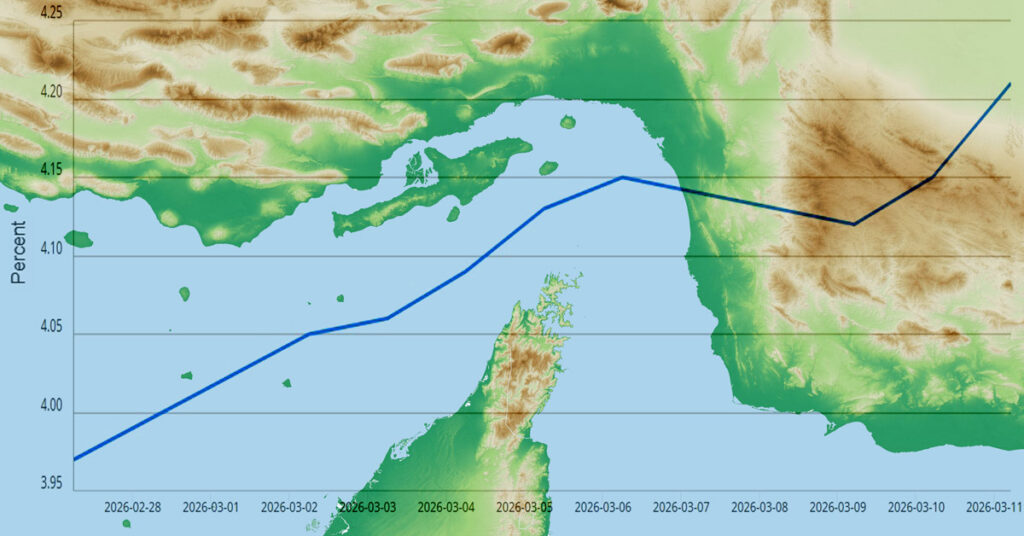
The 10-year Treasury yield, which serves as a benchmark for mortgage rates, has increased during seven of the nine trading days since the U.S. and Israel began airstrikes on Iran on Feb. 28.
As bond investors have digested the ongoing inflationary risks of Iran choking the supply of oil through the Strait of Hormuz, the 10-year yield has risen from 3.952% on Feb. 27 to 4.269% as of the close of core trading on Thursday.