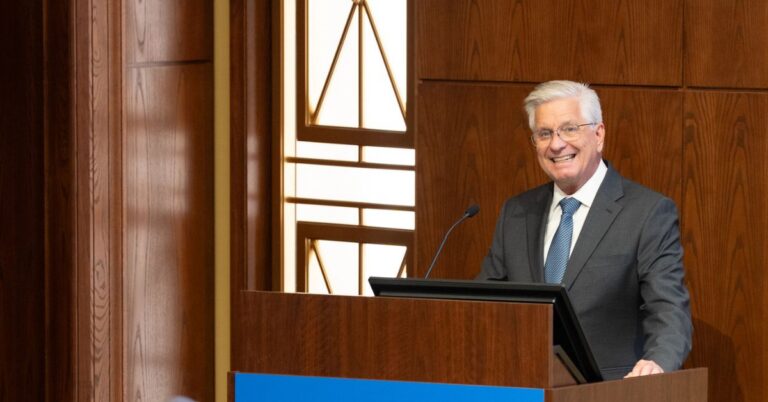

During a speech that offered a cautiously optimistic outlook on the impacts of artificial intelligence on the labor market and U.S. economy, Federal Reserve Governor Michael Barr issued a measured warning.
“We should be prepared for the possibility that there might be serious short-term disruptions in the labor market, even if the long-term gains to society could be quite favorable,” Barr said in prepared remarks delivered Tuesday during a New York Association for Business Economics event.
He added: “In my judgment, now is the time for society to begin to consider how to address these potential disruptions, while AI adoption is in its early stages.”

Referring to AI as a potential “general-purpose technology,” Barr drew parallels to such transformative advances as electricity, the steam engine and personal computers, which achieved “widespread adoption, continual improvement, and a cascade of downstream innovations in new goods or services, production processes and business structures.”
Barr, who has served on the Fed’s board since 2022, as well as the Federal Open Market Committee (FOMC) responsible for setting interest rates, laid out two extreme scenarios for AI adoption.
A range of labor impacts
In one potential situation, “AI capabilities grow exponentially and adoption is extremely rapid, ushering in a ‘jobless boom,’” with AI agents quickly displacing jobs across both the manufacturing and transportation industries and the professional and service sectors.
In another scenario, AI innovation stalls, “perhaps owing to the exhaustion of training data, a shortage of electricity supply or distribution to satisfy the huge demands of data centers, or shortages of the capital required to build all this new infrastructure.”
The more likely outcome, in Barr’s view, is that AI evolves similarly to other general-purpose technologies, and “adoption occurs gradually enough that large and widespread joblessness is avoided” — and despite a short-term rise in unemployment, new jobs emerge to replace occupations displaced by AI advancements.
As it relates to monetary policy, given the Fed’s dual mandate to maintain maximum employment and stable prices, Barr cautioned that short-term investments in AI could be inflationary “if electricity supply constraints from inefficiencies in the power grid collide with strong energy demand from the building of data centers.”
The U.S. Department of Energy reported in December 2024 that data centers consumed 4.4% of total U.S. electricity in 2023, with data center share projected to rise to as much as 12% by 2028. Adding to the surging long-term costs of homeownership, average U.S. residential electricity prices are projected to swell to 17.91 cents per kilowatt hour through the end of 2026, a 36% jump from 2020.
“For all of these reasons,” Barr concluded, “I expect that the AI boom is unlikely to be a reason for lowering policy rates.”
Warsh’s take
Barr’s sentiments contrast with views Kevin Warsh made clear prior to being tapped by President Donald Trump as his nominee to replace Jerome Powell as Fed chair when his term expires in May.
“AI will be a significant disinflationary force, increasing productivity and bolstering American competitiveness,” Warsh wrote in an essay published by The Wall Street Journal in November.
“Productivity improvements should drive significant increases in real take-home wages,” Warsh continued. “A 1-percentage-point increase in annual productivity growth would double standards of living within a single generation.”
Warsh believes those disinflationary pressures will allow the Fed’s balance sheet to be reduced “significantly,” which in turn could enable interest rate cuts to spur the economy and support job growth.
Fed minutes suggest AI caution
Minutes from the FOMC’s January policy meeting reveal a more circumspect approach to evaluating the potential impacts of AI on the labor market.
“Several participants noted that their business contacts continued to express caution in hiring decisions, reflecting uncertainty about the economic outlook and the effect of AI and other automation technologies on the labor market,” the minutes read.
At another juncture, meeting participants “discussed potential vulnerabilities associated with recent developments in the AI sector, including elevated equity market valuations, high concentration of market values and activities in a small number of firms, and increased debt financing.”
The January FOMC minutes also revealed that “a few participants commented that the financing of the AI-related infrastructure buildout in opaque private markets warranted monitoring.”
Central bank policymakers ultimately elected to hold interest rates steady last month, judging that the labor market was slowly stabilizing while the inflation forecast from Fed economists was “slightly higher, on balance, than the one prepared for the December meeting.”
Barr, who voted with the consensus in January, said Tuesday that it will “likely be appropriate to hold rates steady for some time.”
While much of the broader cultural narrative has centered on predictions about AI’s potential impacts on the labor market — which “range from the utopian to the apocalyptic,” in Barr’s words — the ongoing Fed debate suggests that artificial intelligence concerns will also continue to play a notable role in inflation discussions as the year progresses.