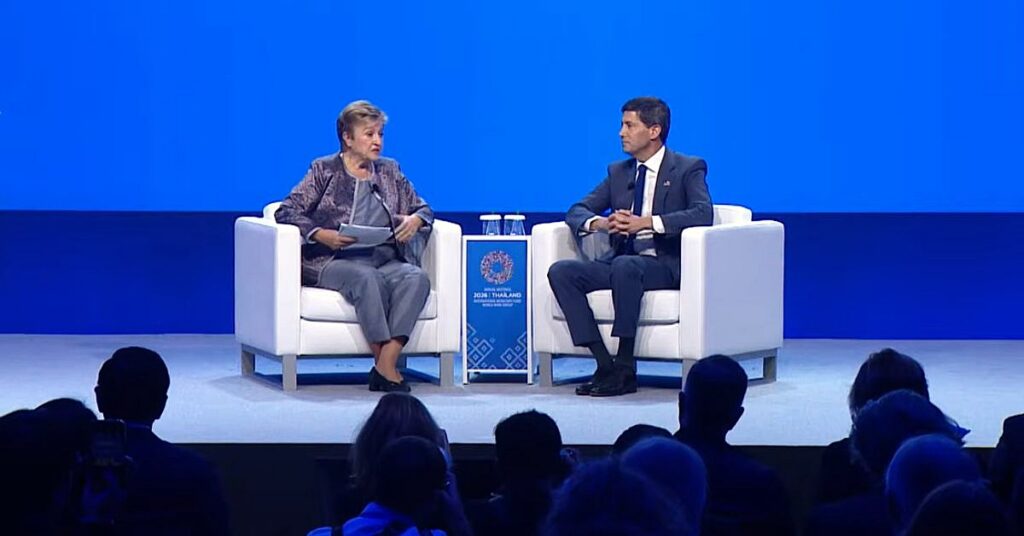
“The defender of price stability” was the honorific bestowed by Kristalina Georgieva on Federal Reserve Chairman Kevin Warsh as she concluded their brief discussion on inflation and artificial intelligence in Bangkok on Friday.
But the managing director of the International Monetary Fund risks putting the cart before the horse just five months into Warsh’s four-year term as Fed chair.
A pair of hotter-than-expected inflation reports hit U.S. markets this week, revealing that five-plus years of above-target inflation has yet to be tamed since Warsh took office in May.

The Fed will enter a customary communications blackout period on Saturday ahead of Federal Open Market Committee (FOMC) meetings scheduled for Oct. 28 and 29. Over two days, the 12 voting members of that rate-setting body will debate whether to raise the federal funds rate for a second consecutive month.
Financial markets hoping for a wink or nod from the Fed chair in advance of that meeting were bound to be disappointed, however.
“I don’t believe in saying now what I might do at the meetings we have in the balance of this year,” said Warsh during the discussion with Georgieva. That personal philosophy to policymaking has prompted the Fed chair to eliminate forward guidance from his policy announcements, cloaking the conduct of U.S. monetary policy in a newfound uncertainty.
“It’s a new chapter at the Fed and we’re not in that business anymore,” reiterated Warsh, whose use of the royal “we” underscores how increasingly at odds his insistence on silence appears when compared with the team of policymakers he oversees.
Filling the communications void
The FOMC voted unanimously in September to raise the federal funds rate by a quarter-point to its current range of 3.75% to 4% — the first such increase since 2023. With varying degrees of urgency, seven of the remaining 11 members of the committee have publicly expressed support for one or more additional hikes to bring down inflation.
In the past two weeks, a cadre of Fed policymakers appear committed to providing consumers and businesses with economic signals missing from Warsh’s public communications.
Fed Governor Christopher Waller and Cleveland Fed President Beth Hammack have deliberately spoken in favor of giving markets forward notice about the trajectory of interest rate policy. Each has flagged the unproductive impact on consumers and businesses of markets pricing in too many or too few policy adjustments.
“Simply put, policymakers could signal where they are likely headed while acknowledging that there is no fixed final destination,” said Waller earlier this month.
Hammack told Reuters in an interview this week: “If someone wants to present me with an argument that says, not speaking is going to help the public and households and businesses make better decisions and understand the economy, and it’s going to help enhance our credibility as an institution, I’m all ears for it. I think it’s a pretty hard argument to make.”
These remarks may look like a mutiny to a chair who says his Fed is “no longer in the business” of giving policy nods. Outsourcing forward guidance to other policymakers only raises the stakes of Warsh’s silence.
AI and inflation
Economists widely agree that higher short-term borrowing rates are unlikely to ease underlying drivers of higher inflation, which include energy supply shocks, scuttled trade alliances and a steep drop in labor supply, as well as massive spending on the AI build-out and Trump administration tariffs.
But slowing resurgent inflation from a series of demand and supply pressures and returning inflation to the Fed’s 2% target are two different policy debates, with the latter possibly requiring much more aggressive action.
On Thursday in Bangkok, Georgieva asked Warsh how central bankers should think about the inflationary impacts of AI over the short term and the long term in the context of monetary policy. AI-related spending and investment is driving roughly half of U.S. economic output.
Warsh, who on multiple occasions has said “inflation is a choice,” responded that AI spending and investment is “obviously hitting the demand side of the economy before it’s going to hit the supply side.” He positioned AI as a “positive supply shock in the medium term,” from which global investors, governments and regulatory bodies are wagering productivity gains and disinflation will flow.
“But on the path to that positive supply shock we’re seeing increases in aggregate demand,” said Warsh. “It just is what it is.”