
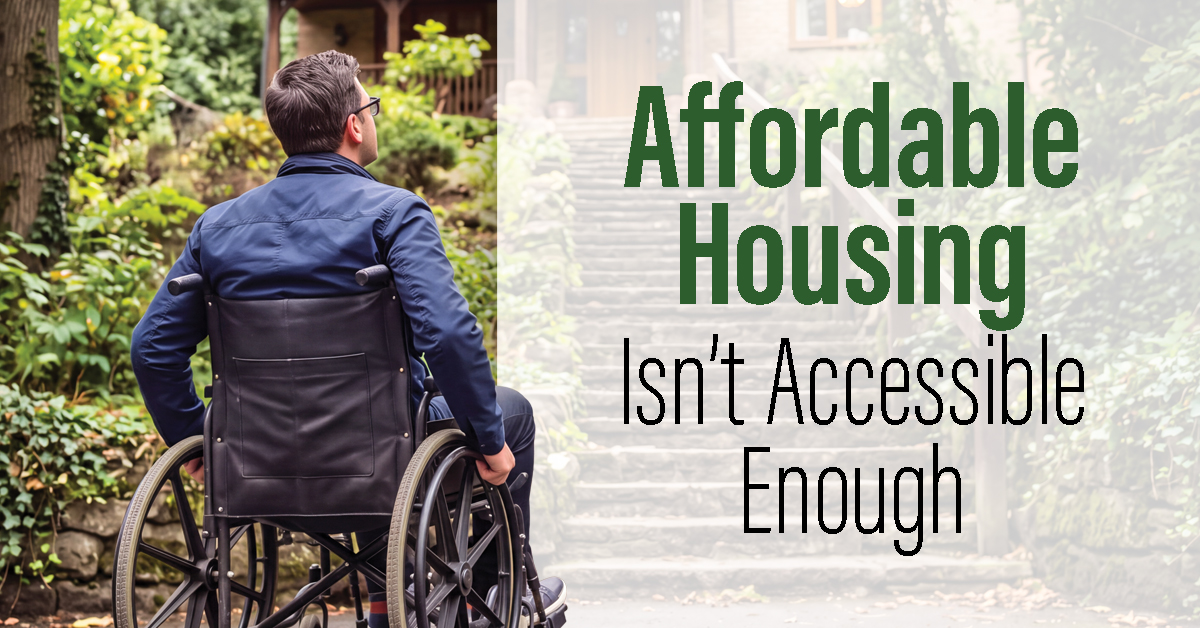
It is widely known that the United States faces an ongoing shortage of rental homes, particularly those affordable to the lowest-income households. But the U.S. faces another housing crisis: a rental housing stock that is woefully ill-equipped to support the needs of households with accessibility needs.
More than 10 million adult renters nationwide either need accessibility features themselves or live with someone who does, such as ramps, step-free entrances and wide doorways. Yet recent research finds that availability of federally funded rental homes with these essential features falls far short of actual demand.
Many renters lack the accessibility features they need because of systemic barriers. Federal fair housing laws generally require landlords to permit reasonable modifications for tenants with qualifying disabilities and chronic health conditions. But the 2025 National Renter Survey from the National Low Income Housing Coalition found that despite these laws, nearly 44% of renters with accessibility needs say landlords are typically unwilling to add accessibility features to a home or building when asked to do so.

In an interview with Shelterforce, Stephanie Thomas, the board president at Accessible Housing Austin and a member of the American Disabled for Attendant Programs Today (ADAPT), described the gap between current housing regulations and enforcement.
“I looked around, and I found that they really weren’t enforcing the law here in Austin,” Thomas said. “I got a list of many of the places where they were supposed to be making [units] accessible, but they weren’t really enforcing that at all.”
The discussion of accessibility in rental housing largely centers on mobility features that make it easier for people to move around their homes or buildings, particularly when using wheelchairs, walkers or other mobility devices.
Unfortunately, at least 65% of renters who need mobility features in their homes do not currently have them. Some modifications, such as ramps and chairlifts, can be relatively straightforward but possibly costly to install in existing rental homes. Other features, including wider doorways and larger bathrooms and kitchens, may require extensive renovations that are beyond the financial reach of many owners of older and lower-cost rental housing.
Other accessibility modifications can be made to existing homes with relatively little cost or inconvenience to property owners. Bathroom safety modifications, such as grab bars and shower safety seats, are among the most commonly needed accessibility features. About 62% of the estimated 8.1 million renters whose households need these features do not currently have them. Nearly 46% of the 4.5 million renters who need smoke detectors and related safety devices that use flashing lights or visual signals in addition to sound do not have them in their current homes. These modifications are critical to ensuring that renters can safely navigate their homes and respond to emergencies.
Accessibility depends on the ongoing maintenance of rental properties. There are many reports of older adults and people with disabilities being trapped in their homes — or unable to return home — for long periods of time due to recurring or extended elevator outages. In-unit repair needs can also pose outsized safety risks to renters with accessibility needs. Damaged flooring, for example, can lead to accidents for people who use wheelchairs, walkers or other mobility devices. Broken air conditioners or heaters can contribute to medical emergencies among older renters and people with chronic health conditions. ⊲
More than 70% of renters with household accessibility needs experienced at least one habitability issue in their current home over the last two years, compared with about 58% of renters without these needs. Yet property maintenance, like accessibility modifications, requires capital that many affordable housing providers cannot readily access.
Financial barriers for low-income renters can also further exacerbate the lack of accessibility to properly equipped rental homes. There are almost 4 million supplemental security income recipients with disabilities in the U.S. However, individuals who receive SSI benefits are limited to $2,000 in assets, and this threshold may be reduced for beneficiaries who have other sources of income, live in a Medicaid facility or live with someone who provides support.
Many SSI recipients have limited income beyond their benefits. In 2026, the maximum federal SSI benefit is $994 per month for an individual, well below the average rent for a basic one-bedroom apartment. Additionally, a housing affordability report from the Joint Center for Housing Studies found that 60% of renter households headed by a person with a disability are cost burdened, 13 percentage points higher than the cost burden share for those without a disability.
For too many low-income renters with disabilities, too little income remains after paying housing to cover basic needs such as food or healthcare. Although housing assistance provided by federal, state and local governments plays a critical role in keeping renters stably housed, these assistance programs for low-income families are often the first targeted for funding cuts. When affordable housing is already scarce, renters who also need accessible homes face an even narrower set of options.
The recently passed 21st Century ROAD to Housing Act is a step in the right direction. The legislation includes a federal pilot program from the Department of Housing and Urban Development (HUD) to provide grants and forgivable loans to low- and moderate-income homeowners and small-scale landlords of income-restricted rental housing to cover the costs of accessibility, habitability and energy efficiency improvements.
“More than 10 million adult renters nationwide either need accessibility features themselves or live with someone who does.”
However, much more is needed to improve the accessibility of the existing housing stock. Effectively supporting renters with accessibility needs requires substantial and sustained federal investment in the construction, preservation and operation of affordable and accessible rental homes.
This includes increased funding for HUD’s Section 811 program, which helps low-income people with long-term disabilities live independently in their communities; the Section 202 program, which supports housing for older adults with very low incomes; and the Project-Based Rental Assistance program, which helps owners keep rental properties affordable to lower-income tenants.
Policymakers should also reintroduce and pass the Visitable Inclusive Tax Credits for Accessible Living (VITAL) Act, which would require 20% to 40% of homes funded by the federal Low-Income Housing Tax Credit (LIHTC) program to be accessible or adaptable for people with disabilities.
States and localities also have an important role to play in making rental housing more accessible. Policymakers can invest in programs that provide capital to housing providers and developers for accessibility modifications. Alaska’s Senior Access Program and South Dakota’s Housing Opportunity Fund, for example, are supported by state funds and administered by state housing finance agencies.
State officials can also incentivize developers and property owners to incorporate universal design and accessibility features in affordable rental units funded by LIHTC through qualified allocation plans (QAPs). These plans specify how states award tax credits to development projects.
The Kelsey, a disability-forward nonprofit developer of affordable and accessible housing, provides a guide for using QAPs to advance accessibility. The organization also encourages state and local governments to improve tracking of accessible rental units and provide housing search assistance so that available homes can be paired with the households that need them.
Accessible housing is essential for millions of renters. And the inclusive design features and modifications that make housing accessible can make homes safer and more useful for everyone.
In spite of this, most housing accessibility needs remain unmet. Sustained federal investment, combined with state and local action, can help expand the supply of accessible and affordable homes, preserve existing accessible housing and ensure that people with disabilities can find homes that meet their needs.