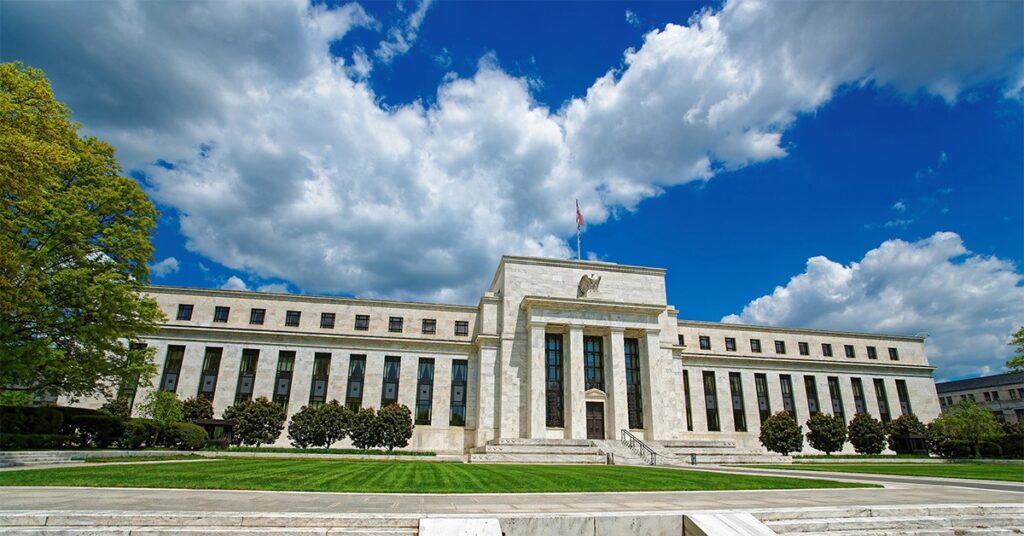
The Federal Reserve held interest rates steady Wednesday in Kevin Warsh’s first meeting captaining the monetary ship.
There was unanimity in the voting results, with no members of the Federal Open Market Committee (FOMC) dissenting.
But the corresponding “dot plot” in the accompanying Summary of Economic Projections showed differing opinions on the path of interest rates by year-end, with eight members of the full 19-member FOMC predicting no change, nine members predicting rate hikes and one forecasting a rate cut.

Taken collectively, the median projection for the benchmark federal funds rate was 3.8% by year-end, up from 3.4% in the previous survey taken in March. Six FOMC members penciled in at least two quarter-point rate hikes in 2026.
One member in the anonymous survey withheld their projection. Heading into the meeting, many Fed watchers predicted Warsh would not provide economic forecasts, which he confirmed in his post-meeting press conference.
“Economic activity is expanding at a solid pace despite elevated uncertainty that owes, in part, to the conflict in the Middle East,” the official policy statement read. “Productivity growth and capital investment are strong. Job gains have kept pace with the workforce, and the unemployment rate has changed little.”
The statement concluded: “Inflation remains elevated relative to the Committee’s 2% goal, in part reflecting supply shocks that have driven price increases in certain sectors, including energy. The Committee will deliver price stability.”
Warsh, along with the 11 other voting members of the FOMC, voted to keep the federal funds rate in its current range of 3.5% to 3.75%, marking his first FOMC vote since January 2011. He resigned from the Fed’s board in March 2011 over objections to an economic stimulus plan involving the central bank purchasing $600 billion worth of bonds.
In April, following Jerome Powell’s last meeting as Fed chair, three FOMC members dissented over an “easing bias” in the policy statement, meaning language implying the next rate move will be lower. The Fed typically cuts rates when inflation slows or the labor market stalls.
That easing language was removed from the notably slimmed-down policy statement in June, which eschewed forward guidance but reaffirmed the committee’s “policy of maintaining ample reserves in the banking system.”
In the intermeeting period, two widely tracked measures of inflation posted scorching hot readings.
The personal consumption expenditures price index — the Fed’s preferred inflation measure — grew at a 3.8% annual rate in April. The consumer price index registered a 4.2% annual growth rate in May. The Fed maintains a 2% inflation target as part of its official mandate.
On the labor front, the Bureau of Labor Statistics reported U.S. employers added a robust 172,000 jobs in May, with the unemployment rate unchanged at 4.3%.
Those reports sealed the deal on the Fed keeping rates unchanged in the eyes of the financial markets, with CME FedWatch reporting nearly 100% odds of a rate hold heading into the June FOMC meeting.